Showing posts with label Looking Glass Gods. Show all posts

Wednesday, June 7, 2017

The Persistence of Wonder by Jane Kindred

As I hinted in my last post, there are times in a writer’s life when the words don’t come easily. The months during which I wrote The Dragon’s Hunt, beginning in November 2016, were some of the worst. When I finished Hunt, I assumed I was over that hurdle, that slogging through mental mud for words. But the next book in the Sisters in Sin series is proving to be just as difficult to write.

But as I said before, writer’s write, regardless of whether the words come easily and regardless of what’s going on in the world around them—and sometimes they write because it’s the only thing they can do.

After my first and second novels got rejection after rejection, I spent eight years in a creative depression, writing nothing. Well, not exactly nothing; I revised both books incessantly. And that did finally come to something with my first break in publishing with my novella The Devil’s Garden; and later, one of my endlessly revised novels was published as the Looking Glass Gods trilogy. But those breaks didn't come until Id finally written something new. And those years of not creating anything felt like not being truly alive.

It’s the main reason I keep going even when I’m not feeling it. Like Buffy Summers sang in Once More With Feeling, sometimes going through the motions is all you can do, with the hope that you’ll feel alive again at some point and regain that sense of wonder that makes you create in the first place.

On Saturday, I was lucky enough to see someone else’s wonderful creation: the new Wonder Woman movie. There were a lot of moments in this fantastic movie that reminded me how important even the smallest acts of resistance are in a dark world. As Steve Trevor said when Diana asked him why he was bothering to do his small part to end the war, “You can do nothing, or you can do something. I tried doing nothing.” Me too, Steve Trevor. Me too. There’s one particular moment later in the film when Diana takes that advice to heart and makes an effort against the darkness that seems impossible, and that impossible effort inspires everyone around her to do the same.

So we do what we can do, even if it may not change the world, and my little bit of something, my act of resistance—against my own darkness and the darkness in the world—is writing about love…and occasionally about punching Nazis.

Writing romance can be a revolutionary act, believing in love and hope when they seem almost impossible. As Diana discovers in Wonder Woman, “only love can truly save the world.” And I am still on the side of love.

Wednesday, October 7, 2015

Going Dark

For those of us in the Northern Hemisphere, the time has come when night and darkness dominate. The weeks between the Autumnal Equinox and the Winter Solstice have always been my favorite time of year, when night becomes longer than daytime in the decent toward its darkest hours.

This is when my candles come out. I love the warmth of candlelight and the romantic shadows it throws, and although I don’t have a fireplace, I love it when the scent of burning wood begins to carry on the crisp fall air as people who do have fireplaces light their first fires of the season.

Perhaps because of the dying light, scent just seems to become more important. The aromas of apple cider and pumpkin pie and warm, wintry spices entice like few others.

And then there are the creatures of the night. Nothing sends a delightful chill up my spine quite like the supernatural: Vampires and werewolves. Demons and dark Fae. Ghosts and goblins and witches. The dark things in our psyches we’re supposed to be afraid of somehow hold a particular romantic attraction. Maybe it’s the unapologetic power they wield or the fact that they exude a feral sensuality. But give me a dark, dangerous beastie over a stalwart knight in shining armor anytime.
Even better if that dark, dangerous beastie is a little bit tortured, damaged, and misunderstood. Or better still, a tragic hero enchanted under a dark curse.

Because let’s face it: everyone looks good in black.

What’s your favorite thing about the season? Are you, too, a sucker for creatures of the night?

By the way, if you’re looking for dark, misunderstood heroes—and heroines—I’ve got them in spades:

Prince of Tricks by Jane Kindred Belphagor, in my Demons of Elysium series, has secrets he still hasn’t told about his past. He’s hinted at them in the Demons series and its companion series, The House of Arkhangel’sk, but he plays his cards close to the vest.

If you like thieves, gamblers, and rogues, and you love m/m erotica and BDSM, Belphagor’s your man. Er, demon. The first book in the trilogy, Prince of Tricks, is a good place to start:

Amazon | ARe | B&N | BAM! | iBooks | Kobo | Samhain

Idol of Glass by Jane Kindred


In my Looking Glass Gods trilogy…well, where do I start? Pretty much everyone here is tortured and full of secrets, but Ra takes tortured to new depths—and heights. In this dark fantasy, heroes become heroines, heroines become heroes, and mortals become immortals.

The final book in the trilogy, Idol of Glass, comes out at the end of this month and is available for pre-order now at the usual suspects.

Amazon | ARe | B&N | BAM! | iBooks | Kobo | Samhain The Lost Coast by Jane Kindred


And my first m/f gothic paranormal romance, The Lost Coast, has a classic broody, angsty alpha hero in Lukas Strand.

A dark paranormal romance about fire, wine, and old-growth forests, The Lost Coast is coming in December and is also available now for pre-order.

Amazon | ARe | B&N | BAM! | iBooks | Kobo | Samhain

Tuesday, July 7, 2015

Does Paranormal Romance Pass the Bechdel Test?

So I’ve noticed a thing.

I read a lot of m/m paranormal, because that’s what I like. But often in m/m—both paranormal and contemporary—there are almost no women, and those women who do appear tend to be one-dimensional. Even though I’m there for the m/m romance, I like to see my gender fairly represented in the fiction I read, even if it isn’t the focus of the story.

I’ve had reviews of my m/m books warn readers that boy/girl touching occurs in a tiny scene, presumably because readers will be turned off by it. But even for my f/f-focused series, one reviewer warned readers of “girly bits.” Looking Glass Gods isn’t m/m and doesn’t claim to be. But the f/f-centric romance is between genderqueer, agendered, transgender, and bisexual characters, so I found it odd that this warning was deemed necessary on a same-sex book reviews site.

The same thing, however, seems to occur in m/f paranormal romance. (I can’t speak for contemporary, since it isn’t a genre I read much.) I recently read one—a very popular one—in which there were literally no other women besides the heroine. None.

You’ve probably heard of the Bechdel Test. Taken from a Dykes to Watch Out For comic strip by Alison Bechdel, it posits a minimum requirement for movies that the woman in the comic is willing to watch. It has to have at least two (named) women in it who have at least one conversation with each other—that isn’t about a man. This is not by any means a standard of gender equality in film (or fiction). It’s the barest minimum criteria for women being depicted as real human beings in a global entertainment medium. And a huge number of movies fail it. But the target audience for those movies is generally men (at least, that’s the excuse that’s given by male-dominated Hollywood). The target audience for romance, even m/m romance, is largely women, and the majority of romance writers (as far as I'm aware) are female.

If women writing fiction for women don’t meet the minimum criteria for depicting our own sex as full members of the world we live in, and if the women reading it don’t want to see other women besides one they can put themselves into as protagonist while enjoying the hot alpha males, what does that say about us? I find it disheartening, depressing, and a little frightening.

Is this a trend anyone else has noticed or is it just that I’m reading too small of a sample? If you've noticed it, do you think it’s more prevalent in m/m or m/f? And what do you think it means?

Saturday, March 7, 2015

Cover Magic

One of the hardest things to get right in the book publishing process, at least from an author's point of view, is the cover. (I'd wager many readers would agree.) As an author, it can be hard to articulate on those cover art sheets just what you have in your head. Often, the best you can hope for is that the cover artist assigned to your book is a professional, even if they don't share your vision. Because when it goes wrong, it can go really, really wrong. But when it goes right? It gives you goosebumps to see that perfect cover show up in your email.

My new release, Idol of Bone, has one of those covers:


Idol of Bone is a book that's been with me for a long time. I know just how Ra looks. I actually drew her myself many years ago while working on the first draft. My cover artist at Samhain, Kanaxa, hasn't seen that drawing, but when I saw the final cover she'd designed, I was amazed at how close to my drawing it actually is. I love the little flourishes and ethereal colors, and I couldn't be happier with this representation of my book.

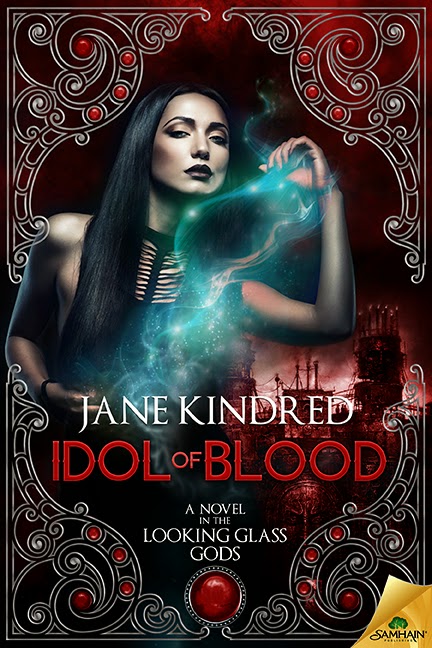
As we started working on Book 2 in the Looking Glass Gods series, Idol of Blood, I figured I couldn't get that lucky a second time, but I knew Kanaxa would give me something good. The first draft of the cover was great—I loved the shot of the model, loved the brooding color and the flourishes—but the model was holding an object that didn't really relate to the book, so I tried to come up with some suggestions for things that could be Photoshopped in, but nothing really worked.

And then Kanaxa said, "Well, she does magic, right? Conjures things? What if I have her conjuring something in her hands?"

"Sounds good," I said. "Go for it."

I just about died of awesome when she sent back this:


And now I can't wait to see the cover for Book 3. :)

One stranger seeks to claim her heart…another is destined to destroy her.

Ra. Just two letters. Barely a breath. When she stumbles into the frozen Haethfalt highlands, her name is all she has—the last remnant of a past she’s managed to keep hidden, even from herself. Her magic, however, isn’t so easy to conceal—magic that’s the province of the Meer, an illicit race to which she can’t possibly belong.

The eccentric carpenter who takes her in provides a welcome distraction from the puzzle of herself. Though Jak refuses to identify as either male or female, the unmistakable spark of desire between them leaves Ra determined to find out what lies beneath the enigmatic exterior.

But more dangerous secrets are brewing underneath the wintry moors. Jak’s closest friend, Ahr, is haunted by his own unspeakable past. Bounty hunters seeking fugitive Meer refuse to leave him in peace.

Harboring feelings for both Ra and Ahr, Jak nonetheless struggles to keep them apart. Because like the sun and the moon coming together, their inevitable reunion has the potential to destroy Jak’s whole world.


Available now in trade paperback and ebook:
Amazon | All Romance eBooks | Barnes & Noble | iBooks | Kobo | Samhain Publishing

Pre-order Idol of Blood, coming in June:
Amazon | Barnes & Noble | iBooks | Kobo

Saturday, June 7, 2014

A Maleficent Cure for the Midsummer Blues

Ah, summertime, the season of no new episodes of your favorite supernatural- and fantasy-themed shows. (And the season of discovering some bonehead in Hollywood has canceled ones you were eagerly looking forward to watching next Fall. Dracula? Seriously?? Have these people lost their minds?) And thus begin the long, dry months before your shows return, when you have no excuse not to write in the evening so you end up watching every episode of Bones back to back on Netflix so as not to have to hear yourself think. Um…that’s probably just me.

Luckily it’s also the season of the Summer Blockbuster, which means lots of SF/F. Which always means lots of inspiration for a writer's fertile imagination. So far, I’ve seen The Amazing Spiderman 2, X-Men: Days of Future Past, and Maleficent. Though I enjoyed them all, Maleficent was by far my favorite, so gorgeous on so many levels. Angelina Jolie was brilliant in this, and the Midsummer Night's Dream-like beauty of the fairyland Moors poked at all kinds of stuff in my writerly brain. It was also a refreshing change for a summer blockbuster and a fantasy to have such a woman-centric cast.

I’ve always thought Maleficent was much maligned in the story of Sleeping Beauty. Even as a child, I was sure she had to have a good reason to do what she did, and after all, the king and queen had been inexplicably rude to her when all the other fairies were invited to Aurora's christening. This was obviously a story told by the victors of a medieval battle against some "monstrous" foe. If the story were from her point of view, the vanquished dragon, it would be very different. And was it ever. If there was anything that disappointed, it was something to do with the dragon, but I don’t want to give spoilers, and that scene was truly wonderful anyway, so I’m not complaining.

Jolie’s Maleficent reminded me very much of one of my own favorite characters, MeerShiva, who appears in my Looking Glass Gods series. Like Maleficent in this tale, her origins are as a sort of protector fairy of the swamp, and like Maleficent, she is horribly betrayed by a human who wants to manipulate her for his own ends. MeerShiva becomes a terrifying goddess of vengeance, although by the time my series begins, she’s become jaded after having lived for centuries and prefers to isolate herself from others rather than bother taking vengeance on—or helping—anyone. Yet somehow, like Maleficent, she finds herself reluctantly embroiled in the life of a charmed child.

For whatever reason, I’ve always enjoyed the powerful female villains in fantasy, where they are often more complex than their male counterparts. My character Aeval in The House of Arkhangel’sk trilogy is another of that breed. She’s been around a long time and seen men do terrible things and thus feels justified in the actions she takes to manipulate the lives of men and angels. I often feel I didn’t do her justice in the first trilogy, which was meant to be one of three: The Queen of Heaven, The Queen of Hell, and The Queen of the Unseen. (Aeval being the latter queen.) I still haven’t written the third, and I’d really like to delve deeper into Aeval’s character and find out exactly what makes her tick. Maybe someday I’ll get to that one.

But in the meantime, I have naughty demons to torment, lost kingdoms to find, lovers to separate, and gods to destroy. (And then there’s all those Bones episodes I still have to finish.) As a writer, I often feel like a supervillain myself, toying with people’s lives and trying to throw as much pain and suffering in their paths as I can before they ultimately triumph. As Prince Humperdinck says in The Princess Bride, “I’ve got my country's 500th anniversary to plan, my wedding to arrange, my wife to murder, and Guilder to frame for it; I’m swamped.” Like any villain's, a writer’s work is never done.