Showing posts with label #writingtools. Show all posts

Sunday, March 10, 2024

Crafting the Future: Why Writers Should Embrace AI by Keri Kruspe


As a writer, I love exploring and learning new things. And lately, I’ve been caught up in the AI craze, exploring what it can do for me in my writing career. But there are some of those in our community who cry foul, claiming AI will soon take over the creative process of fiction writing. Why, they say, pay a human when all it takes is a prompt in an AI software to get you the same thing?

Au contrair, mon frere. In my humble opinion, AI programs (like ChatGPT, Sudowrite, and Claude) are mere tools that help a writer, not replace them. Much like a typewriter back in the day. It won’t hinder the creative process, but instead enhance the experience. With that in mind, let’s take a quick look at what I mean.

What AI Can't Mimic


One of the most important things to remember is we’re humans… writing to entertain/inform other humans. Who, but us, has that kind of insight? Only we can tap into the unlimited variety of human emotions and the baggage we carry with us in all the complexities of being human. AI lacks this innate understanding of our behavior. That gives up the upper hand at creating characters with authentic feelings and flaws, as well as the importance of emotionally growing. Throughout our lives, we’ve wallowed in a plethora of emotions like joy, sorrow, love, coupled with an abundance of longing for something else, something different that only a human can experience.

            Another exciting example of we can do and AI can’t is our innate urge to play with language. This is our palette… what we color the world with. As a writer of SciFi romance, I love coming up with alien and diverse ways to say something. Just recently, I had to ponder what an ancient person (who traveled in time to our present) would say in an exclamation. I’m going to keep it clean here… but some modern man won’t say “Great Caesars Ghost!” (for one thing, Ceaser hadn’t been born yet). So, I had my guy shout “By Tiamat’s titties!”. And I also took a pretty common cuss word that starts with a “f” and ends in a “k” and turned it around for an alien. They say fruk instead. I love coming up with unfamiliar words and phrases for my alien characters to use.

            Another thing I do is draw inspiration from the people I’ve met and work with over the years. In fact, one of my first books is loosely based on real life. Because I felt wronged/betrayed by someone back then, I had the good guy shoot the jerk right between the eyes. Boy, I gotta tell you; that was immensely satisfying. Ah, revenge. Remember, don’t do a writer wrong, they’ll take it out on you in a novel.

Leveraging Technology Wisely

As I mentioned in the beginning, AI is a tool. While it can be used for such mundane tasks as grammar check and research, I love to use it as a writing buddy who is there whenever I need them. Especially since I wake up at the crack of almost-dawn (4:30am to get in two hours of writing before I have to leave for work). I use AI not only as a critique partner, but someone who never gets impatient with me when I ask questions I get stuck on. Sometimes more than once.

            For instance, this morning I was writing a scene in my newest novel and wondered what a tree would look like on a planet where a civilization of panther-like beings of an advanced technology lived. The AI gave me more than one scenario to choose from. So, what I did was combine what I liked best about everything it suggested and came up with something new and different.

To take it up a step, I asked it what one of those creatures would dress like on that type of planet. It came up with several wardrobe suggestions. But the funnest part (yeah, I like the word funnest) was asking it to create a picture depicting this alien.

            And here’s what it came up with:


            Cool, eh? As I planned this blog, I asked the AI to create a picture for the header (see above). When the AI was done, this is what it told me:

            “Here’s an image for your blog post. This visual aims to encapsulate the essence of human creativity and the enduring value of authentic writing in the digital age. It symbolizes the balance between traditional writing methods and modern AI technology, inviting writers to explore and assert their unique voices.”

            Can’t argue with that!

Other Benefits

Here’s an outline of some of the other benefits how an AI companion can help a writer be more productive:

  • Research Assistant: AI can analyze vast amounts of data while providing insights
  • Customization: With some programs, you can customize your AI to adapt to your particular writing style.
  • Enhanced Productivity: It can automate repetitive tasks like grammar checks, proofreading, and formatting. 

·        

Last Thoughts

Will AI replace authors?

As of now, I doubt AI will replace authors any time soon. Most techies and web gurus claim artificial intelligence cannot totally replace a human writer’s insight or their creativity. There is a huge market for creative writers to put themselves out there, to share their experiences with the world.

What we should concentrate on as AI advances is we, as writers, better learn how to use this wondrous innovation. Discover how to strike a balance between automation and human creativity. Use that available technology to save time so you can set your creative juices free. Let it help you weave the magic only you can create to take your writing craft to a higher level.

While AI evolves and algorithms sharpen, remember this: you are irreplaceable. The world doesn’t need another robotic rendition; it craves your authenticity. Embrace your quirks, your scars, and your hard-earned laugh lines.


AI may be the brush, but you are the artist.


Friday, September 10, 2021

3 Tools I Use to Write a Novel Quicker


By Keri Kruspe

Author of Otherworldly Romantic Adventures 


When I began my writing career, I felt like I was trudging through molasses… uphill… in a hurricane to get my first novel ready to publish. Now that I have a couple of years of being published under my belt, I’m beginning to feel more secure in the process. As I’ve explored different/better ways to produce my novels, I’ve heard about various software (other than Word) that other authors rave about. So, late last year, I took the jump and used three different “writing” programs that I can’t live without now.

I find that they not only keep me organized, but they also allow me the freedom of creating my manuscripts at a faster pace.

Whether you are a pantser, plotter, or a plantser (combination of both), I feel you can find something with these three tools that will help you hone your craft. What’s great is that no two people utilize them the same way. I can’t tell you how many times I’ve talked to other authors and am astonished how they use them completely differently than I do.

In this article, I’ll outline the basic info the company gives, and then show you examples how my stuff looks. A bit of a disclosure here: I am in no way affiliated with these companies nor do I receive any monetary compensation for mentioning them in this article. What I say here is my own opinion.

With that out of the way, let’s get started!


Plottr is the newest software I’ve begun to use.

Basically, it’s a downloadable outlining software that makes it easier for me to plot my novels. I love the visual versatility that lets me use sub-plots. They even offer templates to use for planning, everything from mystery to romance.


One of the best features I like is the “Series” tab. Here I can keep a running synopsis of the series I’m writing in now:

I admit I’m a visual. I absolutely love that there are places to create characters, places, and notes that I can add a picture to. Another thing is I can access all of that, no matter what book I’m plotting for.

Here’s a small sample of my series characters:


Another nice thing about Plottr is its ability to track different kinds of attributes. Like flaws or personality traits or magical abilities. I can choose to make these attributes simple one-liners or add a paragraph for extra information.

Plottr isn’t limited to the features I listed above. There are extras that I don’t have space to list, but here are a few examples:

  • I can flip my view when plotting. I love doing this. Sometimes looking at it in a different angle (horizonal or vertical) gives a fresh view of the outline.
  • Navigation is easy. You can scroll through the beginning, middle, and and with ease. 

The one thing that sold me about Plottr is a newer update… I can export it either to Word or to the next tool I want to talk about… Scrivener.

When I first used Scrivener, I’m ashamed to admit I gave up too soon. It seemed way too complicated for me. But, over time, I took a couple of courses (even hard copied the lessons to put in a binder I keep on my desk for quick reference). While I feel I’m scratching the surface of what I can do with Scrivener, I’m plugging along and getting better with each book I complete.

 One of the things I like about it is it supports my need for a visual. What I mean is, for every scene, I can put in a picture on the side that helps me when I must describe something. From a space station, innards to what my villain looks like.


It may be a whimsical reason to use Scrivener, but it puts me in the mood to escape… er, plan my world-building.

Just so you know, Scrivener is not a word processor. It’s more like a tool that focuses on supporting the task of writing long-term pieces. Another feature I really like is the flexibility of moving my scenes/chapters around. I can do that in Word, but then I’d have to copy the text and paste it where I want to. In Scrivener, I just drag and drop. 


I also like the “corkboard” feature. Here I can see my chapters/scenes and change the order here if I like.

In the article “Ten Reasons to Write your Novel in Scrivener” their reasoning is more compelling than mine. One of the other super features is you can export your masterpiece to several formats: Word/ePub/Paperback proofs.

But, before you export anything, it’s best to make sure your creation is as professional as possible. Which brings me to my last tool… ProWritingAid.


Before I began using Scrivener, I used ProWritingAid. When I found out I could use it with Scrivener, I about swooned. Using it from Scrivener instead of exporting it to Word first cut my editing process in half and gave me a good reason to stay with Scrivener. 


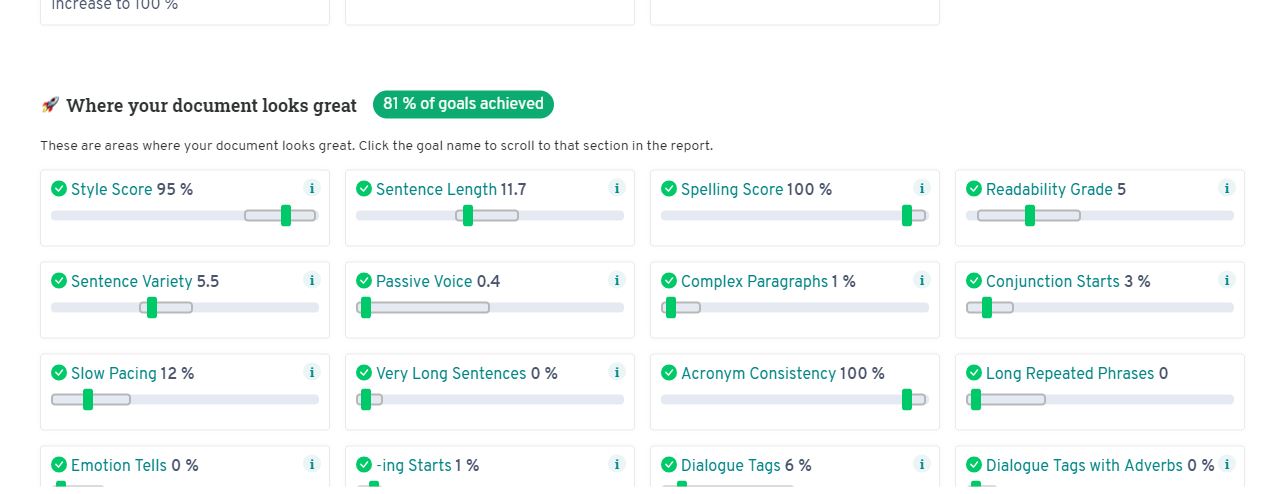
I love how this editing tool not only offers grammar checking, but it also has in-depth reports that can strengthen and polish my manuscript. While I don’t utilize all that they offer, I love the summary that points out areas I could work on.


THE END MATTERS...


When I wrote the first book in my series, An Alien Exchange, it took me over a year from start to finish. Since my goal is to release a book every three months, I’m always looking for ways to become better/faster in creating my stories. One way is to get comfortable with these tools and utilize all they have to offer. I’m hoping that will give me the best chance to reach my long-term goals.


How about you? I'd love to hear about the tools you're using to help achieve your overall author goals!


Friday, April 30, 2021

One-Star Reviews—Nightmare or Dream?


Time to address an elephant in the room, folks: Those one-star (or two-star) reviews, and how authors handle them. (Disclaimer: I am not addressing the vicious, malicious one-star reviews left by ugly, small-minded people. Pretty sure we all agree that those nasty little trolls aren’t worth the air they breathe.)

So, legit one-star reviews…they really aren’t a dream, per se, and to the best of my knowledge not a single author genuinely “loves” them. But, are they all nightmare quality?

My personal opinion is that I’d rather not get any at all, however, when I do, I find that if I detach myself from my initial knee-jerk emotional response, they’re easier to dissect into meaningful, and even helpful input. I can own them.

When I started my author journey, I took to heart some great advice: Not everyone will love your books, and that’s okay! This helped me be more objective when I finally received my first one-star review on Amazon.

Let’s take a look at it. This is from my first book, Prophecy:

“This was a very boring book. The women were in charge and the men were just yes dears. The plot didn't make sense either. Why did one alien from a race of aliens have the right to destroy earth and another alien race? To call for deaths because he wanted to? I was so bored that a skip some parts. Do not waste your time reading this book.

And here is the second one for the same book, which was posted five years later:

“I didn’t get past the first few chapters, I didn’t finish reading this book.

Ouch, right?

Or are they?

I appreciate that the first reader took the time to explain why they didn’t like the story. Boring is their personal opinion, which is at odds with 99% of the rest of the reviews. This is one of those readers who doesn’t love my book, but it’s not a personal attack. They might very well love another one of my stories, or not. If not, then they will never be one of my readers anyway.

The women were in charge…. Hallelujah! This is the coolest statement in support of my story! Why?  First, because the women aren’t “in charge.” In this alien culture, they are viewed as equals to the men. They are respected, and hold positions of authority. Not everyone sees this as a good thing, unfortunately. On the other hand, other potential readers might look at this review and think, “Hot damn! Girl power!” and 1-click the snot outta this puppy.

Second, if the men were all “yes, dears,” then the hero would not be the senior captain of an entire fleet, would he? He would have been a she instead, and that would’ve turned this into a completely different story in a completely different genre.

The plot didn’t make sense. What a beautiful red flag that this pantser (an author who doesn’t outline or plan a story) needs to keep an eye on her plots/sub-plots. Even my developmental editor has pinged me on goal, motivation, and conflict issues (GMC) for a couple of subsequent books. Just telling a story is not enough. One of my weak points, I get it.

The right to destroy/call for deaths. Um, conflict? Without it there isn’t much of a story? (Note to reviewer: This kind of thing happens in real life all the time. It’s tragic.) I love this comment because it confirms that the villain’s GMC did not resonate with the reviewer. The underlying message here to me: Work on this, stupid!

Skipping over parts. Yikes. This might explain why the reviewer didn’t understand the roles of men and women in this culture, and found the plot confusing. Skipping parts in any book can be detrimental to the reading experience in general, but more so with an emotional, action-packed 90K word novel. If you skip, you’re gonna miss something important!

That being said, the onus is on me to be alert for other such mentions. If this becomes a common thread in reviews for other books, I need to take a closer look at why, and fix it.

Do not waste your time reading this book. Once again, this is a personal opinion that doesn’t stack up to most of the rest of the reviews. I’d be lying if I said this one didn’t hurt, but it isn’t my job is to please everyone. I could do everything right, and there will always be someone who doesn’t like it. And I’m okay with that.

What’s my take-away from this review, you ask? GMC is a potential weakness, one that I’ve since owed and am working to improve. Now when I start a new project, I loosely outline my chapters, and I write out the GMC for each of my main characters, as well as for the overall story arcs. I’m not a full-blown plotter, yet, but meeting myself in the middle is working for me so that makes it a win.

Sadly, the second review is all personal opinion/preferences. I do wish this reviewer had given me a little more to go on so I could understand why they got through only a few chapters before giving up. But, they didn’t, and to get my panties in a bunch trying to figure it out is bad for my mental health. <Cue Let it Go! here.>

I have found that writing is a learning and growing process. Authors are always trying to improve their writing, and reviews provide an excellent tool to uncover potential weaknesses.

So, readers, has a one- or two-star review ever influenced your book purchases? What are the triggers that get you to 1-click a book?

Authors, my way is not the only way. Do reviews of your books help you, or do you avoid them? Why, or why not?

Until next month!

~Lea


~*~*~

Bonus new release announcement!

Loved by Aliens has landed near you. Prepare to abducted by out-of-this-world heroes from nine popular SFR series. Yes, you read that right: Nine books from nine different series all for the price of one! But only for a limited time, so grab your copy today.


This set includes full-length books by:

New York Times Bestselling Author S. E. Smith: River’s Run

USA Today Bestselling Author Grace Goodwin: Viken Command

USA Today Bestselling Author Skye MacKinnon: Alien Abduction for Beginners

USA Today Bestselling Author Demelza Carlton: Ghost

USA Today Bestselling Author Debbie Cassidy: Rogue

USA Today Bestselling Author Lea Kirk: Above the Storm

Becca Brayden: Alien King Crashes the Wedding

Kate Rudolph: Synnr’s Saint

Nancey Cummings: Have Tail, Will Travel 

Aliens, take me away!