Showing posts with label #kerikruspe. Show all posts

Wednesday, April 10, 2024

Not Retired, Just Rewriten: My Leap into Full-Time Writing by Keri Kruspe


This year, approximately 4.1 million Americans are crossing the significant milestone of reaching retirement age, a time traditionally viewed as the juncture for winding down one's professional endeavors.

However, trust me to take a break from convention. Instead of slowing down, I'm embracing this pivotal moment not as a finale but a chance to take a leap forward. In this article I’m going to get a little personal. I’ll share my journey of trading in the security of my secular job to pursue a passion that's been driving me for the last five years. Something that’s been simmering deep inside me since I was in my preteen years. Living the life of a full-time author.

Join me as I navigate the transformative phase of redefining 'retirement' and embarking on what promises to be the most fulfilling chapter of my life yet. But first, I’d like to take a quick look back at the last sixty years and the events I lived through. While I’m only giving one important event that shaped each decade personally and overall, it gives you a taste of what helped shape my life.

1960's

Civil Rights Movement:

This was a pivotal series of events aimed at ending racial segregation and discrimination against African Americans and securing legal recognition and federal protection of the citizenship rights enumerated in the Constitution and federal law.

Personal:

The moon landing. Even though I was a young child, I remember sitting with my family in front of the black-and-white TV and mesmerized by the blurry images.

1970's

Watergate Scandal:

A major political scandal that occurred following a break-in at the Democratic National Committee headquarters at the Watergate office complex in Washington, D.C., leading to the resignation of President Richard Nixon in 1974.

Personal:

Ah, puberty and the teenage years. In high school, I was a nerd, complete with red hair, glasses, and freckles, and couldn’t care less about politics. I was on the yearbook staff and part of the literary club. Right after high school, I met and married my bubby, giving birth to my first child.

1980's

End of the Cold War:

Although the process was complex and stretched over the decade, significant events such as the fall of the Berlin Wall in 1989 symbolize the end of the Cold War, leading to the eventual dissolution of the Soviet Union in 1991.

Personal:

Gave birth to my second child. Started a career in banking and spent the decade moving up the ranks, reaching Assistant Manager. My hubby and I bought our first home to raise our children.

1990's

The Internet Revolution:

The decade saw the commercial rise of the internet, transforming business practices and society, and leading to the dot-com bubble. It profoundly changed the way we communicate, access information, and do business.


Personal:

Gave birth to my last child. Became a VP in the bank with over 300 employees – then got laid off after 21 years with the same company. The 90’s were a time of growth for me. After fourteen years, my hubby and I got divorced.


2000's

September 11 Attacks:

In 2001, terrorist attacks on the World Trade Center and the Pentagon had a profound impact on the nation, leading to significant changes in U.S. foreign and domestic policy, including the War on Terror and the introduction of the USA PATRIOT Act. I was actually 2000 miles away from home in a training session. Took me a week to get home.


Personal:

Began dating hubby, making sure I took it slow and easy. We eventually remarried (still together today… our relationship stronger than ever!). Worked at various financial institutions in several different capacities. 

2010's

Rise of Social Media and Smartphones:

While not a single event, this decade was marked by the widespread adoption of smartphones and social media, significantly impacting social interaction, politics, and information dissemination.

Personal:

Moved from Nevada to Michigan. Worked for several banks and credit unions. Towards the end of the decade, I published my first book.

2020's (so far)

COVID-19 Pandemic:

The outbreak and global spread of the coronavirus in early 2020 led to massive changes in daily life, economic downturns, and a reevaluation of global health infrastructure.

Personal:

Like those 4.1 million Americans I mentioned at the beginning of this article, I reached retirement age this year. Grabbing the opportunity with both hands, I handed in my notice at the bank and am looking forward to making my writing career profitable.


To quote a famous American, Martin Luther King Jr:

"Free at last, thank God almighty, I'm free at last!"


Friday, November 10, 2023

Myths to Pages: Unveiling Hidden Legends by Keri Kruspe


Whenever anyone asks me why I adore paranormal romance, I’m completely honest with them. With things around us getting crazier every day, to keep what little sanity I have left I’ve got to have an outlet where I can escape in a realm where reality and imagination intertwine. A place full of captivating stories that transport me beyond the ordinary. And I’m not talking just about well-known paranormal creatures like vampires and werewolves, even though they are still some of my favorites. Besides them there exists a treasure trove of lesser-known myths, legends, and cultural folklore that are waiting to be unearthed and woven into the tapestry of the paranormal romance narratives.

Today we’ll embark on a journey of discovery and explore the art of how we can find and adapt these hidden gems into our own writing. My intent is to not only showcase how this genre is captivating readers with twists in their enchanting tales, but how we can weave them into our own stories.

At the end I’ll share some recommendations that got me started on this journey.

Unearthing Forgotten Legends

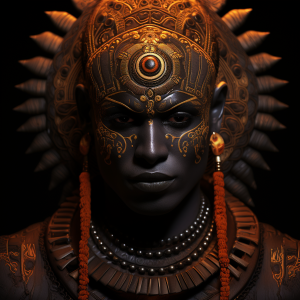
Orisha Deity


First, as a writer, how do we find new and exciting legends to delve into? In today’s ability to delve into any subject at the touch of a keyboard, it’s easy enough to examine other cultures we aren’t familiar with! Deep in the depths of thousands of ancient cultures as well as regional folklore, the world is brimming with stories that have yet to be told. If we go beyond the familiar tales of Western mythology, there are rich narratives of African, Asian, Indigenous, and other cultures. For instance, the Kitsune of Japanese folklore, shapeshifting fox spirits, offer a captivating twist on the classic shifter trope. The Yoruba tradition's Orisha deities, with their intricate personalities and powers, have intense tales that add layers of depth to any character. Just look at the thriving popularity of Japanese anime to see what I mean.

Best of all, by unearthing these forgotten legends, we can infuse any paranormal romance with a global mosaic that can’t help but attract a new base.

Weaving Cultural Authenticity

As with any new endeavor that involves a culture you aren’t familiar with, it's vital to approach them with sensitivity and respect. I know how excited I get when I’m researching a new idea. I try to understand the historical, cultural, and societal contexts where these myths originate. If you can, engage with experts and immerse yourself in their expertise. That way you not only enrich your writing but also honor the cultures that have nurtured these stories for generations.

Breathing Life into Characters


Hidden legends offer a trove of inspiration for character development. The figures within these myths often possess unique attributes, flaws, and motivations that can serve as a blueprint for any paranormal romance protagonists as well as the villains. For example, drawing from the Slavic myth of Rusalka, a water nymph can bring both love and danger to your story. She’s a complex character who struggles with her dual nature. Here’s an interplay of light and darkness that adds layers of complexity, making her more relatable and engaging to readers.


Redefining Supernatural Powers

This is one I struggle with all the time. How to I make this age-old legend and turn it into something new and exciting? Incorporating lesser-known myths lets me reimagine the supernatural powers that drive any character. The Irish Banshee, for instance, could have premonition powers that come with a haunting cost, adding depth and tension to any romantic journey.

Creating a Richer Story World

A paranormal romance isn't just about characters. It's also about the world they live in. Hidden legends can serve as the foundation for building intricate and immersive story worlds. Especially for someone like me who writes SciFi romance, a sub-genre under the paranormal umbrella. Without this key element, my romance adventures fall flat. I’ve got to work through the architecture, landscapes, and societies of other worlds that inspire my fictional settings. I may adapt elements like mystical forests, ancient temples, or ethereal realms as a backdrop where my romance unfolds. My goal is to take my readers in a world that is both magical as well as believable.

Tapping into Emotional Resonance

This is a biggie for me. One of the greatest advantages of our cultural legends lies in their ability to evoke deep emotions. Many of these stories are steeped in themes of love, sacrifice, betrayal, and longing—themes that resonate powerfully with readers. As a writer, I do my best to adapt these narratives so I can capture the essence of these emotional currents. My intent is to layer the narrative and infused them into the relationships, conflicts, and journeys of my heroes. By doing so, I strive to create a profound connection that lingers with readers long after they've turned the last page.

Conclusion

In the realm of paranormal romance, where imagination reigns supreme, the sky (or universe!) is the limit for creating boundless storytelling. By venturing beyond the well-trodden paths of popular mythology and delving into the hidden legends of cultures around the world, it’s easy to unearth a wealth of inspiration that can invigorate anyone’s writing. Keep in mind any adaptation requires diligence, respect, and creativity. But, oh the rewards are immeasurable. Now you’ll have a tapestry of characters, worlds, and emotions that captivate readers and breathe fresh life into the genre.

So, embark on this journey of discovery! Let the hidden legends guide your pen to create tales that enchant, intrigue, and touch the hearts of all who read them.

And, as promised, here is a small handful of some of my favorite paranormal romances that started me on my paranormal romance journey:


Leave your comments here... we'd all love to hear your recommendations!

Monday, July 10, 2023

Beyond Boundaries: Discover the Enchanting Universe of Qhasheik's Pod by Keri Kruspe


This month I wanted to spotlight my latest release, the novella Qhasheik’s Pod.

This book is special to me since it’s my first attempt at writing a novella. I’d never published a short story around 30,000 words before and was worried I’d screw it up. To make it more challenging, Qhasheik’s Pod is a love story different from anything I’ve written before. It explores a throuple relationship between one female and two males—all aliens.

Nary a human in sight.

Good thing my characters made it easy. 

The trio was first introduced in Alien Legacy: The Vampire. There we find they raised the heroine of the story, Jelena, and ended up a predominant part of it. They’re also have a huge part at the end of the series in Alien Legacy: The Mage.

By the time that series ended, there were still some unanswered questions involving our three lovers. How did they meet? Did they fall in love right away? How did they all end up in the hidden city on the moon?


That’s just some questions about these guys that I deliberately left handing when the series ended. Not to mention how I couldn’t get the three of them out of my mind. I swear they forced me to sit down and write their story.

Nagging little buggers.

Ah, well. Let me introduce the main characters of Qhasheik’s Pod to you. Best way to start is with Qhasheik himself.

Qhasheik


Qhasheik, a male Ibbin from Peinuewei, is the captain of the merchant spaceship, Phytro. He and his crew of three other males are suddenly caught in a massive power wave that threatens to destroy them. Desperate for a way out, they spot a rogue planet and hastily head towards it in hope of making a safe landing. 

Sadly, their journey ends in disaster. When Qhasheik regains consciousness, he discovers instead of safely landing, his ship is destroyed on a planet called Akurn. And him the only survivor. Taken into custody by the strange-looking aliens, he’s sold into slavery.

I found Qhasheik to be an unforgettable protagonist. He's a smartass who doesn't fear the opinions of others, confident in himself and his decisions. But, while he might appear to be invincible, there is a chink in his armor. With his home planet gone, he struggles to come to terms with the overwhelming grief of losing his people. And as the sole Ibbin on Akurn, he finds his solitude crippling, at times more than he can bear.

That is until he meets Abiditan.

Abiditan


            Abiditan appears to have it all. The second-born son of a high-ranking family on the rogue planet Akurn. He has wealth, is handsome beyond belief, and considered being one of the key minds in the nobility.

            He’s also labeled unclean, an outcast. The Akurns are a bigoted society where anyone who doesn’t fit into their idea of perfection runs the risk of being executed. Even with something as small as having been born with two separate eye colors. One eye is a normal blue green hue of an Akurn but the other is steel-metal gray. Even this minute deviation is considered an abomination, especially among the upper class. He may have the unwavering love of a doting family, but the longer he stays on Akurn, the more he not only puts his life in danger, but those of his loyal family as well. In a desperate attempt to avoid execution, he fakes his death and joins other rebels from Akurn to start up a hidden city underneath the Earth’s moon.

            There he meets and falls in love with Qhasheik. They form a tight bond and are positive life couldn’t get any better. That is until they meet Katsuki. 

Katsuki


            Katsuki comes from the planet Runihura, a matriarchy society that is first introduced in Chloe’s Turn. She comes from a successful family that owns and operates a mining colony on one of their moons called Narkata. We meet Katsuki coming back from a vacation on a pleasure planet with her college bound daughter when their spaceship suffers unexpected engine problems. She and her daughter would have died in space if it weren’t for a rogue planet answering their stress call.

To their horror, they find themselves on the infamous planet Akurn known to be a highly patriarchal society that refuses to provide women, especially aliens like Katsuki and her daughter, any rights. Both are arrested and sold into slavery for being unclaimed females. To make matters worse, the Akurns separated them. Just before Katsuki is sold into the pleasure houses infamous for their brutality, she’s given the opportunity to join some Akurn rebels to create a hidden society on Earth’s moon. Now, with some semblance of freedom, she believes she’ll have the resources to find her daughter.

            After settling on the moon city, Katsuki stumbles on Qhasheik and Abiditan. From the moment she meets them, she knows they are her aruu, her eternal mates. 

            Qhasheik claims his two companions are now part of his “pod”, a bond the Ibbin’s calls their immediate family.

From There...

            The series that this novella stems from finishes with the liberation of all Akurns from the harsh monarchy of Sub Prince Murduk. At the request of the ruling galactic government called the Federation Consortium, our three heroes are instructed to take the vile villain to Katsuki’s matriarchy home planet for sentencing.

            And that’s when the fun begins….


Saturday, June 10, 2023

Stellar Romance: SciFi Love on the Big Screen by Keri Kruspe


As I grew into teenagehood, (is that even a word?) I had an older cousin who introduced me to the exciting world of science fiction novels. She encouraged me to read the classics: Heinlein, Asimov, as well as Herbert. I devoured those books, and hungered for more until I reached my early twenties. By then, I found a new love.

Romance novels.

Jude Deaveraux, Julie Garwood and my all-time favorite, Kathleen E. Woodwiss. For the next couple of decades, that was the only genre I’d read. Until Paranormal romance came out. Then I discovered Christine Feehan, Sherrilyn Kenyon, and Amanda Ashley.


It never occurred to me that anyone would ever combine my first love with my second. Even though some of the old-timies (H.G. Wells’s The Time Machine is a perfect example) of blending romance with science fiction. But the underlying opinion in the science fiction world is the two genres are completely different. After all, science fiction is more about logic (no offense, Mr. Spock) and contain a variety of futuristic concepts about space, time travel, aliens, or time-traveling aliens in space. These stories seemed to be too complex and rich in detail and didn’t have time for something as mushy as romance. Folks immersed in the genre argue their favorite type of entertainment can’t possibly have anything in common with a trashy romance novel. They pooh-pooh the mere idea of reading any SciFi romance book because they’d never lower themselves to do such a thing.

Humph. I’m here to tell you they do it all the time. To outline my argument, instead of books, I’ll look at some of the most popular science fiction movies since they’ve been seen more than any book read in recent years. And all of them contain a formidable romantic theme.

Avatar (2009)

James Cameron's Avatar is a groundbreaking science fiction movie that tells the story of a paraplegic marine, Jake Sully, who travels to the planet Pandora to explore its rich natural resources. There, he meets and falls in love with Neytiri, a Na'vi princess, and becomes embroiled in a battle between the humans and the Na'vi.

While the movie is primarily known for its stunning visual effects and action sequences, you’ve got to admit the romantic thread between Jake and Neytiri adds an emotional depth to the story and makes it more compelling than without it. Avatar grossed over $2.7 billion at the box office, making it one of the highest-grossing movies of all time.

The Hunger Games: Catching Fire (2013)

The Hunger Games: Catching Fire is the second installment in the Hunger Games franchise, based on the popular book series by Suzanne Collins. The movie follows Katniss Everdeen and Peeta Mellark as they are forced to compete in the Quarter Quell, a special edition of the Hunger Games that brings together past champions.

While the movie focuses primarily on the action and political intrigue of the games, it also explores the romantic relationship between Katniss and Peeta. With is a huge motivator on what drives each of the characters. The Hunger Games: Catching Fire grossed over $865 million at the box office.

The Time Traveler's Wife (2009)

Based on the novel by Audrey Niffenegger, The Time Traveler's Wife tells the story of Henry DeTamble, a time traveler, and his wife Clare Abshire. The movie explores the challenges of maintaining a relationship while one partner constantly moves through time.

Watching how these two maintain their relationship is what drives this captivating story. A lot of movie goers must think so as well, it grossed over $101 million.

The Fifth Element (1997)

OMG – one of my favorite movies EVER! Had to include it…

Luc Besson's The Fifth Element is a visually incredible science fiction movie where a young woman named Leeloo is the only hope for saving humanity from an evil force that threatens to destroy the world. The movie is filled with action, humor, and a whole host of colorful characters. But at its heart, it is a love story between Leeloo and the hero of the movie, Korben Dallas.

And what would this move be without the romantic thread between Leeloo and Korben? Boring, that’s what. The Fifth Element grossed over $264 million at the box office.


The Adjustment Bureau (2011)

I love a movie that keeps me guessing and The Adjustment Bureau did that for me. While the theme of this move explores the concept of free will and destiny, the romantic underlay is the story's foundation. Here we have a politician named David Norris who falls in love with a dancer named Elise Sellas. David and Elise soon find that their relationship is threatened by a mysterious organization that controls the fate of all humans.

While the science fiction elements might be intriguing, it’s the relationship between David and Elise that drives the movie. Lots of folks agree since it grossed over $127 million at the box office.

And last…. But never least…

Star Wars (1977)

(Just so you know, when this movie first came out, it wasn’t called “A New Hope”)

Now I ask you, what would this freakin’ huge spic space opera be without the hint of a romance between Leia and Luke/Han in the first installment? 

And That's a Wrap!

The genre of SciFi Romance novels hasn’t exploded like I would have anticipated in the last few years even though science fiction movies with a romantic thread have been highly successful. Which is odd since these types of stories appeal to both our emotions and our fascination with futuristic worlds and technologies.

Even so, let’s recognize it's the emotional connection between the characters that make any story truly memorable. And, as we saw with the addition of the romantic thread in these movies, we realize romance gives them an added layer of depth that allows the audience to connect on a more personal level they wouldn’t normally have without it.

But I’m hopeful. As us authors continue to explore new science fiction stories with a romantic thread, we’ll do our best to captivate our audiences so our stories will stand the test of time. Just as these movies remind us, no matter how advanced our world becomes, love and human connections will always be at the heart of what makes us human.

Even in space.


Wednesday, May 10, 2023

Crafting a Believable Alien Society by Keri Kruspe


As I start a new science fiction romance series, I pondered what it took to create a believable alien society. Coming up with alien cultures has long since puzzled other writers, filmmakers, and fans of science fiction since the genre first came on the scene. In a lot of ways, it’s more challenging to come up with creating a believable alien society since it comes with all different intelligence, cultural norms and behaviors, and technologies contrary to anything we’re used to. I gotta admit, that’s the kind of challenge that gets me going. Before I know it, I’ve “fallen down the rabbit hole” as I explore ways to create unique alien societies and civilizations.

In this article, I’m going to highlight some elements and principles others used to create believable alien societies that have helped me out. To start, we’ll look at some on examples from popular films that have come out in recent years.


The Nature of Alien Civilizations

When attempting to create a believable alien society, the first thing to consider is what kind of civilization the aliens inhabit. Are they a race of warriors, a species of mystics, or a civilization of scientists and philosophers? Maybe hunter-gatherers, or have they developed complex cultural norms and technologies? Another thought, are they nomadic, or settled in one place? To create a foundation for our story, we need to these basic questions first.


One of the most studied alien societies is that of the Klingon Empire from the Star Trek universe. This warrior species is governed by a strict code of honor and glory. The Klingons are a remarkable people, striving to uphold the strength and courage they value. Their culture is steeped in tradition while their advanced technology enabled them to develop complex societies. They are a fascinating yet believable people that serves as an excellent example of an alien society.

The Na’vi, from the movie Avatar, are another species of aliens with an interesting culture. These natives of Pandora have a deep connection to the land, other creatures, and all life on their planet. Their spiritual bond to nature is strong and they revere the balance of life. Even though they are peaceful people, they fiercely defend their homeland when threatened. 

Not all extraterrestrial civilizations need to be advanced or sophisticated. The aliens in Steven Spielberg's E.T. don’t look to be very technical, even though they possess space travel capabilities. There are hints these little guys are a peaceful species, and while they have their own language and customs, their society doesn’t come across as highly structured. I also didn’t get the feeling their community was rigid or organized. Even so, it still comes across as convincing and intriguing.


The Psychology of Aliens

Now that we have the basic idea of what kind of society we want, we’ll have to create an understanding of the psychology of these aliens. This means understanding how they think and feel, how they interact with each other, and how they view their world. It is important to consider the values and beliefs they share, and how these result in their actions and decisions.

For example, let’s examine another favorite Star Trek aliens, the Vulcans. They are a logical, emotionally detached species, driven by their philosophy of "Infinite Diversity in Infinite Combinations". They strive for perfection and believe in the pursuit of knowledge and understanding. These beliefs shape the way the Vulcans interact not only with each other, but the galaxy around them. They have an intricate social hierarchy and a strong sense of loyalty and duty. 


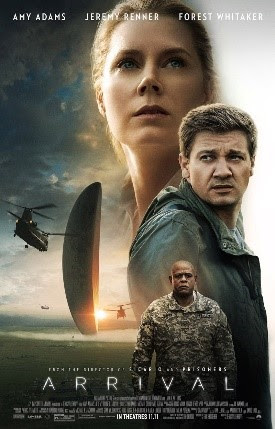
The aliens in the movie Arrival are another example of a society with an intriguing psychology. The heptapods, as they are known, are an advanced race that communicates using a complex language based on symbols. They have a deep understanding of time and a unique view of the universe. They are mysterious and enigmatic, and their alien psychology is an integral part of their culture and society.


Technology and Culture

Making sense of the technology and customs of an alien society helps make it more realistic and interesting in a story. Their technology (no matter what level) is essential to most alien societies. As a writer, it’s important to consider how the aliens apply their technology. For instance, the Klingons are a highly advanced species, with formidable weapons and spacecrafts. They have conquered the ability to navigate interstellar journeys in relative security and freedom.

The Na'vi may not be as highly tech-savvy compared to the Klingons, but their approach to technologically is rooted in a unique type of science. It’s an organic, interconnected practice that bonds them with the planet and all its creatures. Through mental connections, they control animals and plants while collecting knowledge and strength.

The technology and culture of an alien society can also help to create an immersive and believable world. The planet Coruscant in the Star Wars universe is one such example. It is an ecumenopolis, a planet-wide city filled with advanced technology, bustling with activity and energy. The culture of Coruscant is rich and vibrant, and the world feels alive and believable.


(The picture here is my rendering, not the one in Star Wars!)


Conclusion

Creating believable alien societies is a complex and challenging task, but it’s one that has captivated authors and filmmakers (and those who enjoy them!) for decades. While I’ve only touched on the bare surface of what to look for when creating an alien society, I hope you’re encouraged to explore filling your own stories with a smattering of alien psychology, their types of technology as well as how they use it to interface with their culture.

The greatest science fiction tales, be they of love or something else entirely, show us humanity's place in this vast and mysterious cosmos. From the smallest atom to the furthest star, our adventures tap into a shared sense of awe and helplessness; an understanding that despite all our efforts, we may never truly understand the universe we inhabit.


Monday, April 10, 2023

How AI Can Help Strengthen Your Writing by Keri Kruspe


There is a lot of controversy out there about Artificial Intelligence (AI) – especially for those of us in the creative arts. Some view it as the end of civilization, some view it as a much-needed boost to productivity.

I first heard about the two AI’s I’ll outline in the article from Joanna Penn’s podcast. She’s big into AI and even has a course in it. I haven’t decided if I’ll take the course yet, but I like knowing it’s there if I need it.

Whatever you view about AI, I’m not here to persuade you either way. What I am going to do is confess the three new AI programs I’ve started using this year:

Midjourney, ChatGPT, and Sudowrite.


Midjourney

What is Midjourney you may ask? According to designboom, “Midjourney is a chat-powered, artificial intelligence (AI) image-generating tool that can produce realistic images and artworks based on given text prompts”.

For someone like me who can’t draw a straight line, it’s like playing in a candy store. I’m a very visual person who loves to look at pictures when I write. When I write in Scrivener (which can also be considered having AI tendencies), I like having a picture on the page about whatever or whomever I’m writing about.


By the time I’m done with my complete novel, I have several pictures I’ve created that I can include into the finished book. I did that in my latest release, Alien Legacy: The Mage. With each chapter I included two pictures that I made with Midjourney.

That’s not to say it all goes off without a hitch. I’m finding that the AI has a hard time with different color tints (one of my aliens has bright yellow skin and neon eyes with no pupils). It has a hard time with that. So, I fall down the rabbit-hole trying to get as close as possible to what I’m looking for. Sometimes the prompt is so bad, I get nothing like I’ve asked for.

When that happens, I’ve got to be careful. It’s so easy for me to tumble down the rabbit hole. Hours can go by without me realizing it.

Here is an example of what I’m talking about. Bird beak? Where did that come from? I asked for a cyclops. Poor thing just can't give me four arms either. 


How do you know what to put in? Never fear, my friend. Like everything else, just put in the question on your favorite search engine and a ton of video tutorial pop up. Because I’m not very computer savvy, I have to find the ones that go step by step. I’ve been doing this for a couple of months now and am getting better. Lately I've been watching tutorials by Christian Heidorn to help out. 


Chat GPT

Now here’s an AI I can wrap my writer’s brain around. My first attempt with using something like this was ChatGPT. This AI is another chatbot launched in November of 2022. It was built on top of a program called OpenAI’s GPT-3, which has now morphed into version 4. In a nutshell, its a large language model that interacts in a conversational way. The dialogue format made it easy for the program to answer follow up questions and admit its mistakes. It also rejects inappropriate requests. It’s great in creating summaries for new novels as well as a way to have an interactive “friend” read what you wrote and give suggestions on how to make it “better” – depending on what your definition of “better” is. 


I was happy using ChatGPT for free… but the biggest downside became all too clear. More often than not I’d get an error message saying it was at capacity (the room was too full) and to try again later.

At that time, I looked into subscribing, but it was over $40 a month! Ack! From what I understand now, you can subscribe as low as $20 a month. They state they are inviting folks to go on the ChatGPT API waitlist while they develop lower-cost plans.

Because I’m an impatient soul, I looked into another such chatroom and found Sudowrite (again, courtesy of Joanna Penn). 


Sudowrite

One of the best things I like about Sudowrite is how it came about. It was developed by writers for writers. Apparently, the founders were sci-fi writers and fine-tuned the GPT-3 program by using high-quality narrative training data. Writers can use Sudowrite to create new stories or tweak any existing work. 

Pros

Brainstorm characters, plots, worlds, and more.

Expand plot points.

Rewrite to 'Show not Tell'

Describe things for the 5 senses.

Generate Twists.

AI gives feedback mimicking "human" readers.

4000 word free trial with all features included.


Cons

    'Twist' feature is limited to the Sci-fi genre.


I like that it helps you brainstorm. From a single sentence to developing your characters.

 You can also expand your plot to having it describe story elements (i.e. sight, sound, smell, touch, taste and well as an esoteric metaphor).

I admit I haven’t tried half of what Sudowrite offers. I’m still playing around with it!

Conclusion

I’m not looking for any AI program to take my place as a “creative” (which is what Joanna Penn calls us). What I use them for is to give me a helping hand to bring out my own ideas. It’s like having a critique partner at your beck and call 24/7!

I’d like to hear if you’ve had a chance to “play around” with any of these formats. Let us know what experience you’ve had with them. Good? Bad? Either/Or?

Join the conversation and leave a comment below!


Thursday, November 10, 2022

Ancient Alien Descendants: The Series by Keri Kruspe


The thing I like best about being a writer is getting lost in faraway worlds and dimensions that take me away from my day-to-day life. My entertainment of choice has always been the fantastical, whether it’s movies, television, or reading.

In my latest series, Ancient Alien Descendants, I’ve made it a point to merge my romance novels with science fiction along with a heavy blend of paranormal tropes. These stories might center on an alien invasion, but the heroes and heroines who fight against them come with powerful paranormal abilities. Everything from vampires to supernatural wizards.

To celebrate the release of the last book in this series (tentative launch date Valentine’s Day, next year), I wanted to share why I created these adventures like I did.

The Empath

What if you found out you weren’t who or what you thought you were?

When I was a preteen, I imagined once I went through puberty or reached the advanced age of sixteen, a life altering “something” about me would change. What if I got powers like Samantha on Bewitched? What if I didn’t belong here on Earth but instead was a princess of some other dimension? What if I wasn’t even human?

Turns out the only thing that happened when I turned sixteen was having an embarrassingly set of large boobs. Which, I suppose, might be considered its own superpower.

For the first adventure in this series, I started with a woman named Julienne who had no idea she was anything but a lonely woman in her early 30s who worked at a stressful job in a bank. Turns out she was part of the secret set of quintuplets created by aliens separated at birth. 

As the story continues, she meets a devastatingly handsome man by the name of Ben who annoys the crap out of her. By accident she stumbles on him secretly investigating criminal activity going on in the bank. They end up being cohorts trying to uncover the same thing. While their adventures take them to the moon and back, she finds out the more she’s with him, the more her empathic psyche talent comes out.

Imagine going through life unaware of what other people feel until one day it all careens into you? How would you handle experiencing other volatile emotions? And what if you found out not only could you feel other people’s emotions, but you could manipulate theirs? How would you handle that? 

The Shapeshifter

If you could turn into anyone, who would you choose to be?

I had a lot of fun with this one. The second brother in this series by the name of Pete is a complete smartass. While Pete didn’t have as much psychic talent as his other brothers (the heroes in this series are a set of quintuplets as well), his main ability is being able to shapeshift. And not just turn into a werewolf, or a Dragon, or some other animal. This man could turn into anything his little heart desired. Even another person. All he had to do was touch someone in order to morph into them.

The heroine in this story, Jena, never knew she had the same talents Pete did until they met. And the more they were around each other, the higher her abilities manifested. By the end of the story, she didn’t even have to touch a person to turn into them.

One of the other parts of this story that I got a blast writing about was one of Jena’s pets, an overweight Siamese cat by the name of Bubbas. Turns out Bubbas is anything but an ordinary feline. He is the son of the Egyptian goddess Bastet with the body of a muscular man and the head of a Siamese cat. He and his kind had been sent to Earth as guardians with strict protocols about how much they were allowed to get involved with humanity’s evolution.

The Psychic

What if aliens abducted you and turned you into something not human?

For some reason, this book was one of the hardest ones for me to write. I’m not sure if it had something to do with trying to describe true psychic ability, or the thought of my heroine being forcibly turned into something different.

Or maybe it had something to do with Michael and Jordyn being middle children. I know as a middle child I struggled to find my own identity. It seemed that everything my siblings did overshadowed what I tried to accomplish (why can’t you be more like…). I found myself floundering when old resentments raised its ugly head as I worked through the adventures these middle children endured.


Turns out, like her sisters, Jordyn was unaware she was anything but a human. In the story, she was abducted by the aliens who experimented on her. A crazy alien scientist decided to add their DNA to her to give her more power. Fortunately for her, what they did was tone down her natural psychic ability that being around Michael unleashed. Instead of becoming overloaded with reading minds and speaking telepathically, their little test gave her a way to handle her new reality.


The Vampire

What if you fell in love but they loved someone else?

Now who doesn’t crave a good vampire romance story?

Since the male protagonists in this series have lived for thousands of years, I wanted to make their lives the bases for most of the human myths. Enter Zamush, the epitome of a tall, dark and handsome vampire. Rather than being a soulless demon, Zamush was someone who needs extra blood to live, thus the fangs. He also enjoys all the vampiric tropes: teleporting, flying, ability to enthrall his “blood donors”.

And arrogance. Can’t have a vampire without their firm conviction of being on top of the food chain.


That’s where Jelena comes in. She hardly pays attention to Zamush since she’s obsessed with a man she’d never met (fangirl syndrome gone wild). For once in his life, he has to put effort in to even get noticed.

Unlike her other three sisters, Jelena knows she is anything but human. Raised in a hidden moon city by some rebel aliens, she has the same attributes as Zamush. But, being a vampire has its drawbacks. All her life she suffered as an outcast even among those who are different.


The Mage

Could you face your worst fears if it was the only way to save mankind?

The finale of this series is a little different than the other rest. My heroine, Jazmi, always knew she wasn’t human. I relished giving her, and the hero Raiden, unlimited powers. Everything their brothers and sisters could do, they did better and stronger.

When I started this story, I thought of the gods of old, like Zeus, Apollo and Odin to every other legend out there. And just like those gods of old, my couple came with some very human frailties.

I had to show that having everything at your fingertips isn’t always the answer. These two suffer from the same guilts and insecurities us humans live with daily. I want the reader to experience the heroes struggles as they work through their worst fears before embracing their deserved happily ever after.


To prove that even superheroes are all too human.

Sunday, January 10, 2021

Is a bad review something to cry about?


Let's start the new year by taking a sensitive subject and putting a "good" spin on it! Let's learn how to welcome bad book reviews!


“This is actually a horribly written boring piece of literature…stay away from this disgustingly overrated book and disgustingly bad writer”. -  Review of Harry Potter and the Sorcerer’s Stone by J.K. Rowling

“This collection of books is really, really terrible and boring, and I would(n’t) wish the task of reading it on my worst enemy.” - Review of The Lord of the Rings by J.R.R. Tolkien

“I’d like to say the book has potential, but I don’t think it did.” – Review of The Hunger Games by Suzanne Collins

“… the alien politics in the story were, at times, over analytical and complex. I would’ve preferred a simpler approach.” – Review of An Alien Exchange by Keri Kruspe


(Okay, I admit I’ve given myself a bit of a cheap thrill putting my name up there with those distinguished authors. I actually love this critique…I had no idea I was smart enough to write something “over analytical and complex”!)


Let’s face it. As a writer, we have to have reviews on our books to make a living. Reviews are the lifeblood of the industry. In order to sell books, we have to have more than ten reviews for Amazon to even notice we’re alive. Not to mention places like BookBub – there you aren’t going to get a coveted place in their ads without lots of reviews.


So, What are book reviews?

The basic principal of book reviews is to help a reader decide whether or not they want to purchase/read a book for themselves. A review shouldn’t be a summary of the novel, just an overall opinion of the work.

And, as you know, everyone has an opinion on just about everything. Why should books be different?


Show me an author who hasn't gotten a bad review...

A quote from Isaac Asimov: “Writers fall into two groups: Those who bleed copiously and visibly at any bad review, and those who bleed copiously and secretly at any bad review.”

I think what he was trying to say is “join the club”.

If you don’t believe me about authors getting a myriad of reviews, a great site to check out reviews of your favorite author is idreambook.com. They have a collection of critics (i.e. NY Times) that rank the best-selling books according to the percentage of good reviews.

So, if you’ve ever gotten a bad review, you’re in good company.


Do we really need bad reviews?

I understand the question. But ask yourself this: Why do I write? Do you do it for yourself? Or do you want others to enjoy the fruits of your labor? I mean, holy crapoly…being a published author is hard work! We struggle for years learning our craft only to find out writing a novel is just the beginning of a lengthy process. We are constantly putting ourselves out there…in social media, blogs, websites, and author pages on numerous sites.

Why put ourselves through this torture?

One answer is we write to gain reactions from others. We cross our fingers the reactions come back good. But then, you get hit with a “bad” review. You’re being attacked and minimizing all the hard work you’ve done (not to mention the expense!) to get your baby out in the world as you pray it grows and thrives.

In response, I propose to you a different idea:


Bad reviews sells books!


Huh? Say what? How is that possible?

Let’s say you’re browsing through your favorite digital site looking for your next favorite book. Ah, a cover and title catches your eye…the blurb sounds great. But you’ve never heard of this author, so you scroll down to look at the reviews.

Yep, there they are.

Wait, they have nothing but five-star reviews. Gushing on and on how “unputdownable” the book is and that it’s the greatest novel ever.

Oh, come on! People are diverse on everything. Folks can’t even agree on what kind of ice cream is best. How is it everyone loves this book without fail?  Sounds to me like this writer got all his friends and family to write a boatload of fanny-kissing reviews. Worse, it comes across as dishonest.

Now sprinkle in a couple of “bad” reviews. Wham, we’ve got a dose of realistic legitimacy. The “bad” reviews actually balance out the “good” ones. It gives a sense of genuineness to the work.

Perspective

One of my favorite quotes comes from Kurt Vonnegut about book reviews. “Any reviewer who expresses rage and loathing for a novel is preposterous. He or she is like a person who has put on full armor and attacked a hot fudge sundae.”


Let’s look at it another way.

Some people look for negative reviews to look for a book they’d like to read. I’ll use myself as an example. The worst review I’ve gotten (so far…) is for the second book in my trilogy. “I personally don't like there to not be returned karma for the ones who did all the torture, rape, or whatever. The reasons behind why the bad guy was not imprisoned and punished before now were stupid.” – Review of D’zia’s Dilemma. 

I love this two-star review. I mean, really! Why would I “punish” the bad guy in the second book of a trilogy? That would be like Darth Vader facing justice in The Empire Strikes Back instead of in Return of the Jedi. As a reader, I’d love to know the action continues in the third book.

There can be some quirks in bad reviews that nudge me to take a closer look:

“too many ridiculous characters” – yay! My favorite part of any book (or movie) are the secondary, quirky characters.

Any review that sneers at the word “feminist” – since I write about “feisty heroines”, this could wind up being my kind of book.


10 Quick tips to handle bad reviews

I came across this great article from Indie Author News on the best ways to react when you get a bad review:

  • Do nothing
  • Do NOT respond (unless it’s a simple “thank you”)
  • A bad review is still a review
  • Re-read your good reviews
  • Beware the Troll – Don’t pour gasoline on the fire
  • Ignore the bad review
  • It’s not personal, it’s business
  • Don’t rush to your favorite social media site
  • Get tough skin
  • Remember why you write

The article also gives some fun (not to be taken as realistic) ways to deal with bad reviews:

  • Drink – heavily if need be 
  • Shop – for yourself…not others!
  • Respond to the reviewer why they are a douche-bag
  • Use coercion, extortion, blackmail, or torture to make them take it down
  • Turn about is fair play… give them a bad review
  • Print it out and then burn it
  • But…most of all… 

Write your next book!